
Hi, I’m Christina Feriadi, an SEO specialist and the creator of Voyager.ink.
When I first applied to Google AdSense, I genuinely believed my site was ready. My content was optimized, the design looked clean, and everything followed basic SEO best practices, especially principles I later refined in my guide on how to write blog posts that rank without keyword stuffing
Still, I got rejected.
That moment forced me to stop thinking like a blogger and start thinking like a reviewer inside the Google AdSense program. I realized something important:
AdSense approval is not just about content quality. It is about trust, completeness, and user value.
If your site feels unfinished or lacks credibility signals, it will likely be rejected, even if your articles are well-written.
This guide will walk you through the exact reasons why applications fail and how to meet the real AdSense requirements.
The rejection
Have you created a blog that is SEO optimized, but still got rejected for a number of policies, like me?
When the warning and reason for rejection is “low value content”, even though your content is rich and informative, what you might want to check is:
- Have an “About Us” page
- Have “Privacy Policy” page
- Include “Terms and Conditions” page
- Mention that you use Adsense in your “Privacy Policy” page. State that you have ads on your website and you’ll make money with
- Have enough content (more than 30 blog posts)
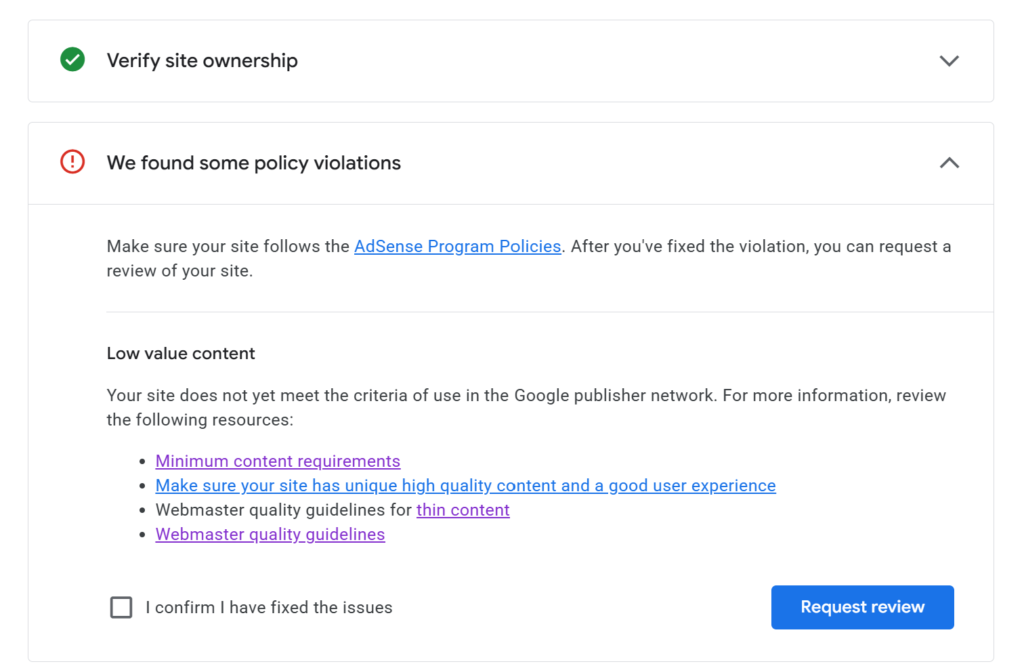
The Most Common AdSense Rejection: “Low Value Content”
One of the most frustrating rejection messages is:
“Low value content”
This often confuses bloggers because their articles may actually be informative and SEO-optimized.
Here’s the truth:
Low value content does not always mean bad writing. It often means your website is missing key elements that signal trust and authority.
The Real AdSense Requirements You Must Meet
To improve your chances of adsense approval, you need to focus on the fundamentals that Google expects from every publisher.
1. Create Essential Trust Pages
One of the first things I fixed after my rejection was adding proper trust pages.
Every site applying for adsense approval should have:
- About Us
- Contact Us
- Privacy Policy
- Terms and Conditions
These pages are not optional. They show that your site is legitimate and transparent.
In your Privacy Policy, clearly mention:
- You use ads (or plan to use Google AdSense)
- You may earn money from advertisements
- You use cookies and tracking technologies
This aligns your site with basic adsense requirement guidelines.
2. Publish Enough High-Quality Content
Another major factor in adsense approval is content volume and consistency.
Applying with only a handful of posts is one of the fastest ways to get rejected.
Aim for:
- At least 20 to 30 blog posts
- Articles that are detailed and helpful
- Content that solves real problems
This builds topical authority and signals to Google that your site has depth.
3. Show Real Experience and Authority
One of the biggest differences between sites that get adsense approval and those that do not is authenticity.
Google values experience-based content more than generic information.
Instead of writing:
“Here are tips for blogging”
Write:
“Here is what worked for me and what failed when I tried it”
This approach increases your chances of adsense approval because:
- It builds trust
- It demonstrates expertise
- It creates unique content
4. Improve Website Structure and User Experience
Even with great content, your site can fail adsense approval if it feels incomplete.
Ask yourself:
- Is navigation simple and clear?
- Do categories make sense?
- Does the site load quickly?
- Is the design clean and readable?
Google evaluates how users interact with your site. A poor experience can reduce your chances of adsense approval.
5. Make Your Website Look Like a Real Brand
One key insight I learned after my rejection is this:
Google does not approve “test websites.”
Your site needs to feel like a real project with clear purpose and long-term value. It should look active, trustworthy, and built for users, not just monetization.
To achieve this:
- Use a consistent logo and branding across your site
- Maintain a clear niche so your content feels focused and intentional
- Publish content regularly to show ongoing effort and growth
- Avoid empty, underdeveloped, or placeholder pages
If your site looks like it was created only to get AdSense approval, it will likely fail. Google prioritizes websites that genuinely aim to help users and provide lasting value.
What I Changed to Move Toward AdSense Approval
After my rejection, I stopped focusing only on SEO and started improving my site holistically.
Here is exactly what I changed:
First, I added all essential pages like About, Contact, Privacy Policy, and Terms.
Then, I expanded my content library to include more in-depth articles that provided real value.
I also shifted my writing style to focus more on personal experience rather than generic advice.
Finally, I improved the overall structure and user experience of my site.
These changes aligned my site with the real adsense requirement standards and significantly improved my chances of adsense approval.
Common Mistakes That Delay AdSense Approval
If you are struggling to get AdSense approval, you may be making one of these mistakes:
Applying Too Early
Applying before your site has enough high-quality content, clear structure, and consistency often leads to rejection, as Google may see your website as incomplete or not ready for monetization.
Writing Generic Content
Content that lacks originality or simply repeats what is already online does not perform well. Google prefers unique, valuable insights that demonstrate expertise and offer something different to readers.
Ignoring Legal Pages
Not having essential pages like a Privacy Policy, Terms and Conditions, or Disclaimer reduces trust. These pages show your site is legitimate and compliant with basic online standards.
Poor Navigation
If your website is difficult to navigate, with unclear menus or disorganized categories, it creates a poor user experience and signals low quality, making approval less likely.
Focusing Only on SEO
While SEO helps drive traffic, Google also evaluates trust, usability, and overall user experience. A site optimized only for rankings may still fail to meet AdSense quality standards.
How to Get Approved for Google AdSense Faster
If your goal is to speed up adsense approval, focus on building a strong foundation.
Start by ensuring your site is complete and professional. Then, consistently publish valuable content that solves real problems.
At the same time, improve your internal linking structure. Connecting related articles, such as linking content about email marketing strategies or paid ads and traffic generation (internal links), helps Google understand your site better.
Most importantly, be patient.
AdSense approval is not instant. It is a process that rewards quality and consistency.
Final Thoughts: Think Beyond AdSense Approval
If there is one lesson I learned, it is this:
Do not build your site just for adsense approval.
Build it for users.
When your website genuinely helps people, provides real value, and feels complete, adsense approval becomes a natural next step rather than a struggle.
So instead of asking:
“How do I get adsense approval?”
Start asking:
“How do I build a website worth approving?”
That shift in mindset makes all the difference.
FAQ: AdSense Approval
How long does AdSense approval take?
It usually takes a few days to a few weeks. However, delays can happen if your site does not fully meet adsense requirement guidelines.
What is the minimum content needed for AdSense approval?
There is no official number, but most successful sites have at least 20–30 high-quality posts.
Can a new website get AdSense approval?
Yes, but only if it looks complete, trustworthy, and provides real value.
Why do I keep getting rejected for AdSense approval?
The most common reason is low value content, which often means missing trust signals or lack of depth.